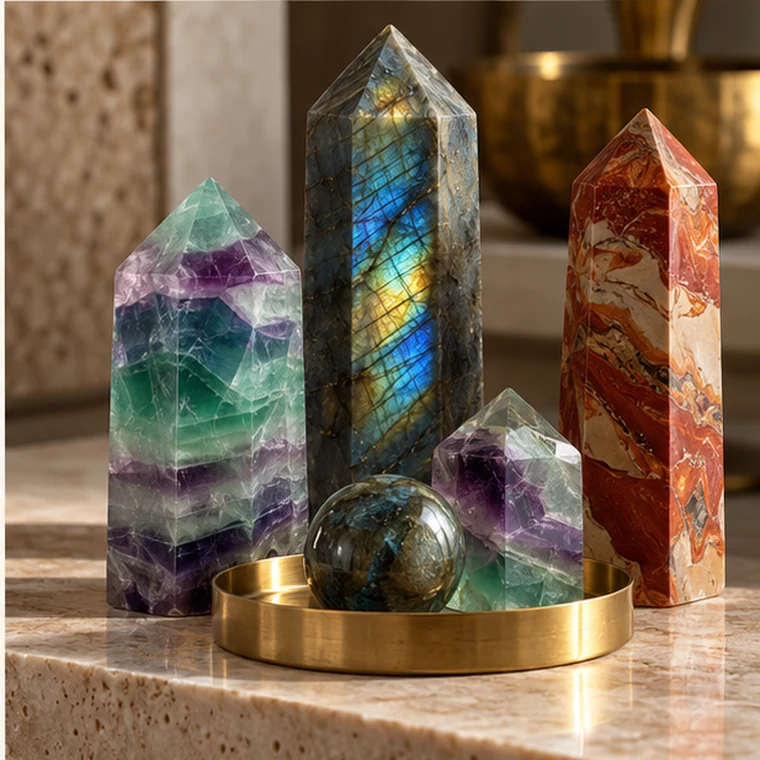
Natural crystals form through geological processes. Laboratory-created or synthetic gemstones are manufactured but have essentially the same chemical, physical and optical properties as their named natural counterparts. Imitations only copy appearance, while treated stones began as natural material whose color or clarity was altered. Clear labeling matters more than assuming one category is automatically “real” or “fake.”
What is the difference between natural and synthetic gemstones?
Natural gemstones form in the earth. Laboratory-created gemstones are made by people but can share the named mineral’s essential composition and structure. The difference may require trained gemological testing. “Synthetic” does not mean plastic or glass, and sellers should identify laboratory origin clearly.
What is a treated crystal?
A treated gemstone is material whose appearance or durability has been changed through methods such as heating, dyeing, coating, irradiation, impregnation or fracture filling. Treatment is not automatically bad, but it can affect value, stability and care. Ask what was done and whether it is permanent.
What are imitation and composite materials?
An imitation resembles another gem but does not share its essential composition and structure; glass and resin are common examples. Composite or reconstructed products combine material with filler, binder or multiple parts. These can be attractive products when they are described accurately.
How do the main choices compare?
| Category | How it is made | Required buyer question | Typical disclosure |
|---|---|---|---|
| Natural | Formed geologically | Has it been treated? | Natural gemstone plus treatment details |
| Treated natural | Natural material altered after formation | What treatment and care? | Dyed, heated, coated, stabilized or filled |
| Laboratory-created / synthetic | Manufactured counterpart | Is it clearly labeled lab-created? | Laboratory-grown or synthetic plus gem name |
| Imitation | Different material with a similar look | What is the actual material? | Glass, resin or imitation gem |
| Composite / reconstructed | Parts or particles joined with binder or filler | What components are present? | Composite or reconstructed material description |
What product and wholesale facts should buyers confirm?
- Materials
- Confirm the exact stone or material, whether it is natural, treated, laboratory-created, reconstructed, composite or glass, and any metal components.
- Size
- Standard reference: approximately 8 mm round beads for an approximately 16–18 cm wrist. Final bead and bracelet measurements are confirmed for the selected design.
- Production
- Designed, assembled and quality-checked in Donghai County, Jiangsu, China. Geological stone origin varies by mineral and production batch.
- Care
- Wipe with a soft dry cloth. Remove before bathing, swimming, exercise, sleep or cleaning. Avoid chemicals, impact, soaking and prolonged direct sunlight.
- Wholesale MOQ
- Standard reference: 50 pieces per design. Mixed assortments and custom specifications are confirmed in the written quotation.
- Packaging
- Individual recyclable paper box and care card. Private-label cards, stickers and custom packaging are available by quotation.
- Lead time
- Samples usually require 7–10 business days; bulk production usually requires 15–25 business days after approval and deposit.
Who wrote and reviewed this guide?
Author: CC, CRYSTALS ENERGY editorial team. Updated: October 25, 2026. Review schedule: CC reviews this guide weekly for material descriptions, care guidance, responsible wording and sourcing facts.
Editorial review: Material and care statements are separated from symbolic traditions. Exact stone identity, treatment, dimensions, price, MOQ, packaging and delivery are confirmed for the selected production batch and written quotation.
Reference sources
Frequently asked questions
Are synthetic crystals fake?
A laboratory-created gemstone can share the essential composition and structure of its natural counterpart. It should be clearly labeled as laboratory-created or synthetic.
Are treated crystals natural?
Many treated stones began as natural material, but the treatment must be disclosed when it affects care, durability, value or permanence.
Can I identify a synthetic stone from a photo?
Usually not reliably. Important identification may require a qualified gemologist and laboratory testing.
Does a low price prove a crystal is fake?
No, but an unusually low price for a rare material is a reason to request exact identification and treatment disclosure.
What should a wholesale quotation include?
It should identify material category, known treatment, dimensions, tolerances, sample approval, packaging, MOQ, price and claims process.
Need product advice or the latest catalog?
Tell us the styles, quantity and destination country you need. We will confirm current materials, MOQ, packaging and lead time.
WhatsApp Chat for Private Customization →