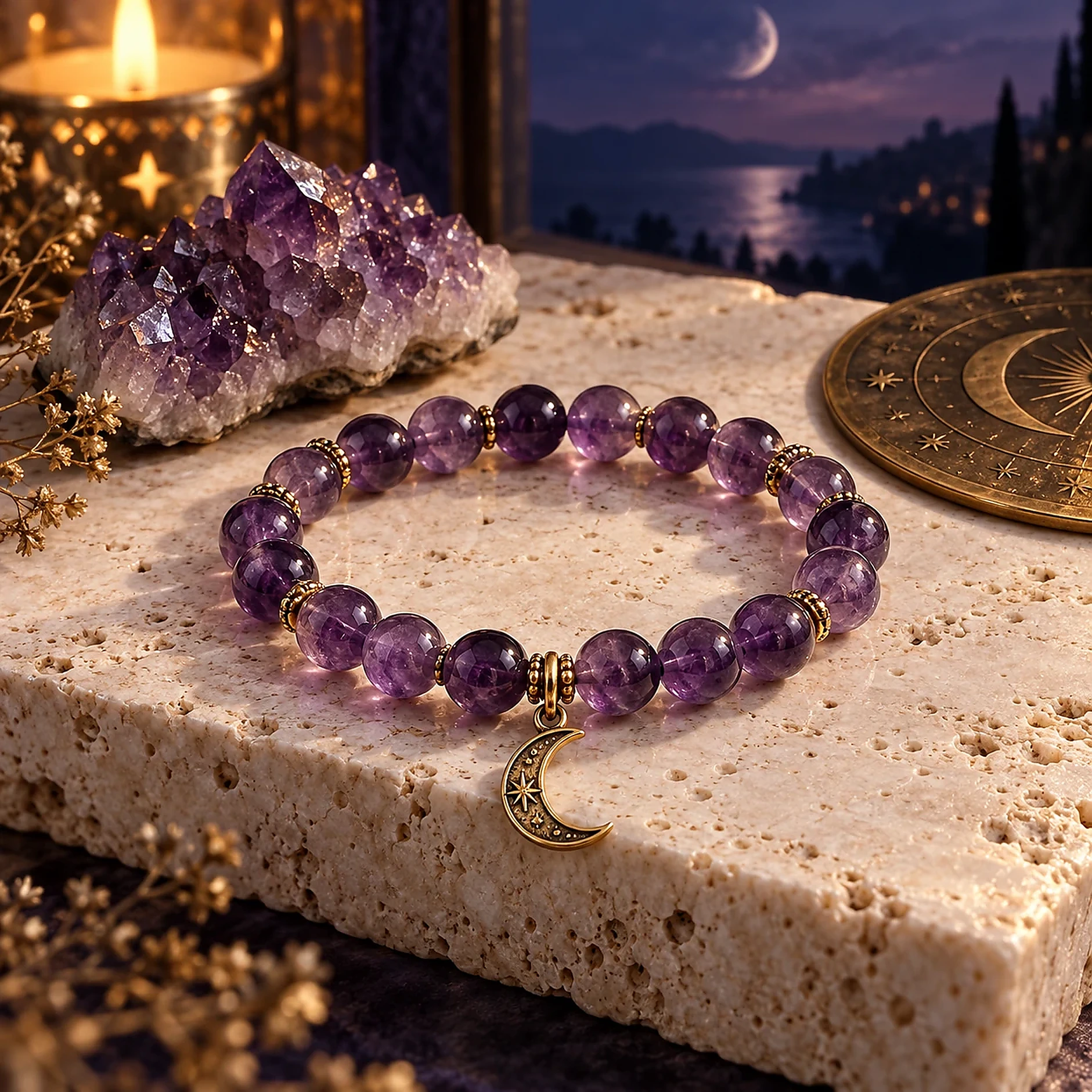
To charge crystals safely, use a non-contact ritual such as setting an intention, journaling, sound, brief moonlight, visualization, placing the item on a clean dry cloth or simply wearing it mindfully. Avoid water, salt and prolonged sunlight unless every stone, treatment, metal, adhesive and stringing material has been confirmed safe for that method.
What does “charging a crystal” mean?
Charging is a spiritual or personal ritual used by some owners to connect a crystal with an intention. It is not a gemological requirement and does not change the stone’s scientifically measured properties. The safest ritual is one that creates meaning without exposing the material to moisture, chemicals, heat or abrasion.
Which charging methods are gentle for most jewelry?
Low-contact methods reduce risk: write an intention, use quiet breathing, play a bell or singing bowl nearby, leave the piece on a dry cloth in indirect light, place it near—but not on—a decorative charging object, or wear it during a short reflective practice. Moonlight is gentle, but keep jewelry indoors and dry.
Why should water, salt and direct sun be used carefully?
Water can affect porous, soluble, metallic or treated materials and can weaken elastic or damage plated parts. Salt can scratch polished surfaces and corrode metal. Light and heat can fade or damage some colored gems. When the material is uncertain, choose a dry, indirect method.
How do the main choices compare?
| Method | Contact level | Main advantage | Important caution |
|---|---|---|---|
| Written intention | None | Works for every material | Keep language realistic |
| Sound | None | No moisture or abrasion | Protect hearing and fragile décor |
| Indoor moonlight | None | Gentle visual ritual | Keep away from open windows and dew |
| Dry cloth ritual | Low | Simple for bracelets | Use a clean non-abrasive surface |
| Mindful wearing | Low | Connects meaning with routine | Remove for water, exercise and sleep |
| Water or salt | High | Popular tradition | Avoid unless every component is confirmed safe |
| Direct sunlight | High | Short traditional ritual | Fading and heat risks vary by material |
What product and wholesale facts should buyers confirm?
- Materials
- Confirm the exact stone or material, whether it is natural, treated, laboratory-created, reconstructed, composite or glass, and any metal components.
- Size
- Standard reference: approximately 8 mm round beads for an approximately 16–18 cm wrist. Final bead and bracelet measurements are confirmed for the selected design.
- Production
- Designed, assembled and quality-checked in Donghai County, Jiangsu, China. Geological stone origin varies by mineral and production batch.
- Care
- Wipe with a soft dry cloth. Remove before bathing, swimming, exercise, sleep or cleaning. Avoid chemicals, impact, soaking and prolonged direct sunlight.
- Wholesale MOQ
- Standard reference: 50 pieces per design. Mixed assortments and custom specifications are confirmed in the written quotation.
- Packaging
- Individual recyclable paper box and care card. Private-label cards, stickers and custom packaging are available by quotation.
- Lead time
- Samples usually require 7–10 business days; bulk production usually requires 15–25 business days after approval and deposit.
Who wrote and reviewed this guide?
Author: CC, CRYSTALS ENERGY editorial team. Updated: October 25, 2026. Review schedule: CC reviews this guide weekly for material descriptions, care guidance, responsible wording and sourcing facts.
Editorial review: Material and care statements are separated from symbolic traditions. Exact stone identity, treatment, dimensions, price, MOQ, packaging and delivery are confirmed for the selected production batch and written quotation.
Reference sources
Frequently asked questions
Do crystals have to be charged?
No. Charging is an optional personal or spiritual ritual, not a care requirement.
Can I charge a crystal bracelet in moonlight?
You can place it indoors near indirect moonlight, but keep it dry and away from an open window, condensation and prolonged sunlight the next morning.
Can I use salt to charge crystals?
Salt can scratch stones and corrode metal parts. A nearby dry bowl used symbolically is safer than direct contact.
How long should I charge a crystal?
There is no scientific or universal required time. Choose a short, practical ritual that does not expose the item to damaging conditions.
Can sunlight charge every crystal?
No. Some stones and treatments can fade or be affected by heat. Indirect light is the safer default.
Need product advice or the latest catalog?
Tell us the styles, quantity and destination country you need. We will confirm current materials, MOQ, packaging and lead time.
WhatsApp Chat for Private Customization →